Thursday, March 10, 2011

The New Homestead Act of 1872

Congress' passage of the New Homestead Act of 1872 spurred new settlement in Kansas. The law permitted soldiers and sailors 160 acres or a quarter section of land. The claim needed to be proved within 6 months.This includes the family of John Finley VanHuss. The warranty deed to Daniel VanHuss and later transfers can be viewed in the Butler County Courthouse in El Dorado.

I have images of the deeds that need to be uploaded.

Read the Daily Eagle of  April 12, 1872. Look to the upper right hand column for a reprint of the Act.


 The New Homestead Act was patterned after the earlier act of 1862. Learn more about this act from the National Archives. (Image from the National Archives).

This article needs editing. There is little information online about the 1872 Act.

Tuesday, March 8, 2011

1900 Census Butler County Kansas, Hickory Township, John F. Van Huss

1. The 1900 US Census of Butler County Kansas showing John Finley Van Huss, his wife Jessie Brewer, and their three children - Beulah, Fred, and Luva.

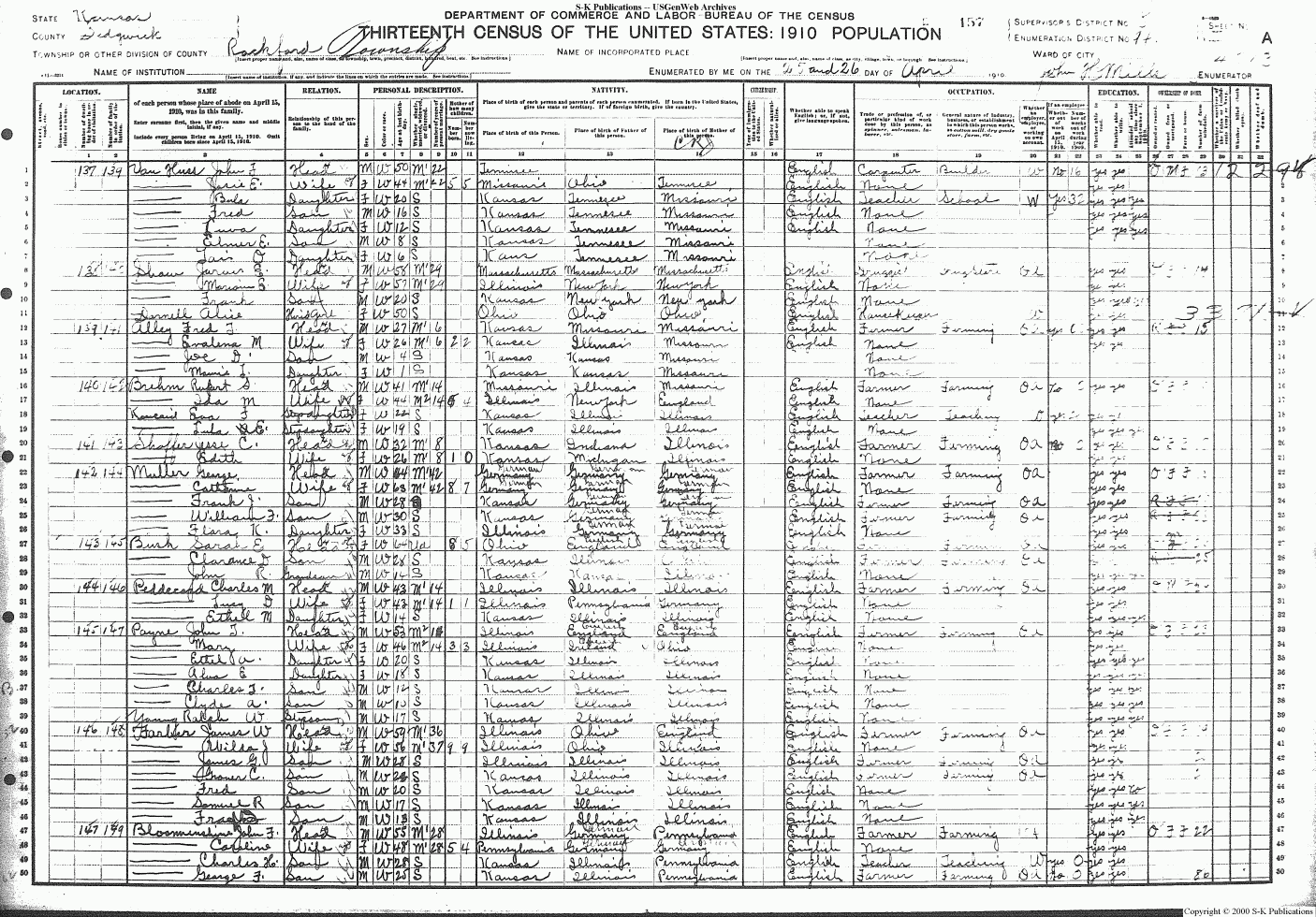
2. The 1910 US Census of Sedgwick County, Rockford Township recording the family of John Finley Van Huss and his wife Jessie and  five children - adding Elmer and Lois to the existing brood.

Rockford Township is southeast of Wichita and includes the present day towns of Derby and Mulvane. The geographic center of the township is 95th St. South and Greenwich.

See the US GenWeb Census Project

Monday, February 21, 2011

Valentine Worley Van Huss

Similar names, early deaths, and multiple marriages often make genealogy difficult to sort out.

Valentine Worley Van Huss

Valentine Worley Van Huss is born in 1818 in Virginia, despite the fact that his father is living near Elizabethton, Tennessee. The Virginia birth may be a result of the many family connections to Virginia. By 1845, Valentine is back in Tennessee. He marries Lucinda Campbell and together they have at least seven children, John Finley Van Huss being the last born in 1859.

All five sons and their father will settle in Kansas after the Civil War. Here is a listing of names and dates of birth.


son date of birth
James M. Van Huss 1845
Isaac S. Van Huss 1847
Daniel Smith Van Huss 1850
Robert E. Van Huss 1857
John Finley Van Huss 1859

John Finley Van Huss, had a son Fred, who had a son Bob, who's daughter Robin is my wife..

Mathias Van Huss

Valentine was born November 1818 to Mathias Van Huss and Elizabeth Worley. The couple married in 1817 in Wythe, Virginia, but lived in Elizabethton, Tennessee. Elizabeth died shorthly thereafter and it is likely that Valentine took his middle name from his mother.

Mathias then married Lovina Dugger. Mathias and Lovina had nine children, several of whom are buried in the Van Huss Cemetery outside Elizabethton, Tenn. Included are Joseph P., Daniel, and Abigail. Family History. From Lovina's will it is evident that she raised Valentine as her own child and considered as such.

Census Records and Valentine Worley Van Huss

1850

 The  US Census of 1850 for Carter County, Tennessee, lists Valentine Worley Van Huss, age 23, as a farmer with 100 acres. He is married to Lucinda H. and father to 3 children - James, Isaac, and Daniel, ages 4, 3, and 2.

Valentines' father Mathias dies in 1856. He may be buried in Johnson, Tennessee.???

1860

The US Census of 1860 for Carter County, Tennessee again records Valentine and Lucinda Van Huss. The family now farms 300 acres near Elizabethton. Valentine's is 42 years old. Sons -  James, Isaac and Daniel are 14, 12, and 10, and are joined by four other children Susannah, Matilda, Robert, and one-year-old John Finley Van Huss. This John Finley Van Huss is great grandfather to Bob Van Huss.


Sunday, February 20, 2011

Van Huss Cemetery, Carter County Tennessee

I visited the cemetery when I was just starting this project, so a lot of information was unavailable to me.

Van Huss Cemetery is just outside Elizabethton, Tennerssee.

Use a Garmin if you can. Otherwise, find the intersection of Wilbur Dam Road and Dairy Lane. Follow the Doe River on the south side. Take Siam Road for most of the way, less than a mile. Go past the Misty River Cafe, past Bowlers Lane, then right on Dairy Lane. Tucked back in a corner of a working farm is the cemetery. Ask for permission to park.

Earlier I had stopped at the Siam Baptist Church and asked for directions. By luck, Glenda Van Huss overheard me talking to another parishioner. Glenda told me that her father's name was Cecil. He is now deceased, but not buried in the Van Huss Cemetery. She was able to direct me to the cemetery, a short distance away.

The cemetery is not large, with less than 30 headstones. The Van Husses buried here are half brothers to Bob Van Huss' ancestor Valentine Worley Van Huss. These Van Husses are the sons and daughters of Mathias Van Huss and his second wife Lavinia Dugger.

The oldest names are brothers Joseph P. and Daniel S. Van Huss. Sadly, the marble headstones are worn by the elements and the dates of birth and death can not be read. The brothers married sisters, Rebeca Nead and Elizabeth Nead. Fortunately, Rebeca's birth and death dates can be clearly read as born "Jan 1834, died Sept 1922, at the age of 88". Other family members are buried in the cemetery. There is one headstone with the name Van Huss visible, and a civil war reference to possibly the "12th inf".

You can find Joseph P. and Daniel S.Van Huss in the 1860 Census of Tennessee. Then in Goodspeed Hisatory of Carter County is J. P. Van Huss, born March of 1833, husband of Rebeca Nead, and a short biographical history.


Friday, October 22, 2010

Kansas Indians

There were many tribes inhabiting Kansas before the advent of white settlers. The Kansas Indians for whom the state is named were first visited by Lewis and Clark on their expedition in 1802. The Kansas camped along the Kansas River where Lewis and Clark encountered them. Around 1846, they would settle near Council Groves on the Neosho River and a reservation was established. By 1873, this land was sold and the Kansas were relocated to Oklahoma.

Along the Arkansas River where present day Wichita is were the Wichita Indians for which the town is named.Coronado encountered these Indians on his futile hunt for the Seven Cities of Gold in the 1540's. James Mead described his dealings with the Wichita in his book, Hunting and Trading on the Great Plains. the Wichita lived in established communities, living on a mix of agriculture, hunting, gathering, and fishing. See Wichita Indians in Wikipedia for more.

The image to the left (Wikipedia) may not be descriptive of the Wichita Indians. Archeological excavations indicate that originally the Wichita lived in large grass huts, some as large as 30 feet in diameter. And their life styles were certainly affected by the destruction of game by the white settlers.

Soon after Missouri achieved statehood in 1821, the Osage were relocated to Indian Territory in Kansas and Oklahoma. The Osage tribe inhabited a portion of southeastern corner of Kansas including the area near present day Butler County. George Catlin (Chief Tah-le image by George Catlin from the NPS.gov) described the Osage as "the tallest race of men in North America, either red or white skins; there being few indeed of the men at their full growth, who are less than six feet in stature, and very many of them six and a half, and others seven feet." The Neosho River was named by the Osage, and the Osage River is named for them. The departure of the Osage from Kansas opened the door to large scale immigration by white settlers in and around the area of Butler County. The Osage ceded their lands to the United States Government in treaties made in 1825, 1865, and 1870.

There were many other Indian tribes living in Kansas. A good description is given in an article by aaanativearts.com.

The article gives a good description of the many eastern tribes who were relocated to portions of Kansas. The article notes the many Indian place names that exist today in the names of counties, rivers, and cities in Kansas. Traveling north along I-35 for instance one comes across the cities of Ottawa and Paola, and travels through the county of Miami.

David Rumsey has online a beautiful map by E. B. Whitman and A.D. Searl of eastern Kansas in 1854 showing several reservations of Indian tribes. There is a drawing of the destroyed Eldridge Hotel on the map that reflects the turbulence of early Kansas history. A reproduction of the image can be purchased from the David Rumsey Map Collection starting at $24.95 and going to $189.95 for a large image.

When the Indians Lived Here

The subject of Indians in Kansas is obviously a large one. There are many issues which historians can write about but not resolve. From time to time I will add some thoughts.

Several great books describe life on the Plains before the settlers moved in. My favorite for this area is James Meads', Hunting and Trading on the Great Plains. The first book I read as a teenager is, the more well-known book by Francis Parkman, The Oregon Trail. (I will try to add others as I come across them.)

Mead's recollection is perhaps the better account of the two stories, as he was one of the original founders of the city of Wichita. His book depicts in detail coming to Kansas from Iowa, his encounters with the Indians, and the trials and tribulations of starting a new life then. Parkman's account recalls the heady days of the hunters who first encountered the Indian and buffalo on the High Plains.

There are other histories. We are fortunate to have online the full text of the illustrated History of Butler County, written by Vol. P. Mooney and published in 1916. There are several online sources for this book.

Once Kansas was a land where hunters of buffalo and antelope roamed. Here and there a few Indian settlements existed.  The Wichita, Kansas, and later Kickapoo and Pawnee were the tribes which originally inhabited the area, but they were later joined by other tribes as eastern tribes were relocated forceably west of the Mississippi. Even with the presence of Indians, a person could wander for days across open plains and through wild woods without seeing another human.

Much of Indian life centered around the buffalo hunt. Two major hunts were organized each year - the first in the spring and summer from May until August, and the second in the late fall, from September until December. The hunting followed the migration patterns of the buffalo from southern Oklahoma as far north as Canada. Buffalo once roamed in herds estimated to be as large as 30 million, but these herds were largely destroyed by the late 1870's.

Washington Irving came west in 1832, following the Arkansas River near the present day cities of  Stillwater, Oklahoma City and Norman. He shot elk and encountered bear, buffalo, deer, turkey, and wild horses. It was not uncommon then to see flocks of one thousand to two thousand turkeys.

We can only imagine life as the Indian lived it. There are no known accounts that I am aware of. But, I will look for them. We are only left with the imaginings of the white trappers, hunters, and farmers who first came and then interacted with the native tribes. Mooney in his History gives us his thoughts in Chapter Five at page 64.

Let us turn back the hour and traverse the years and the changes.
A panorama touched with the brush of the master artist, the description
of which is beyond the power of the pen. Picture the beginning; the
wilds of the wolf and the coyote, the bounds of the buffalo, the deer, the
elk and the antelope ; the primitive home of the Red Man, his wigwam,
his tribe, the little Indian village planted among the trees at the water's
edge ; the stream where the red children played and grew to the stature
of men and took up the life of their fathers, hunting, fishing, sleeping,
fighting, stealing and passing on to the Happy Hunting Grounds, thank-
ing the Great Spirit for life and opportunity.


Mooney also repeats a story by Mead of an Indian encounter in 1863 in Butler County:

"In 1863 there came from the south camps of Kickapoos, Shawnees, Delawares and others who settled on the Walnut and Whitewater. These Indians were the friends of all the wild Indians of the plains, and so long as they remained, the southwestern frontier was safe from hostile attack. The Kickapoos I mentioned lived in the Indian Territory, or Texas, and were kinfolks and friends of the Kickapoos in Old Mexico.At the close of the Civil war, or about the fall of 1866, they outfitted at my place (Mead's Ranch on the Whitewater, present location of Towanda) and all left for Old Mexico directly across the county. They knew the country well, and were the finest body of Indians I ever met — brave, honorable, noble and were expert hunters. There were not over thirty men with families. Their lodges were models of neatness and comfort. The Shawnees and Delawares I mentioned also lived in the Indian Territory before the Civil war and returned."

[typographical errors corrected]

Thursday, October 21, 2010

1840. 1850 and 1860 Federal Census of Carter County, Tennessee

The 1840 U. S. Census for Carter County, Tennessee at page 195, line 12, lists Mathia (Mathias) Van Huss, wife and seven  children. The names and ages of other family members are not given. One child was Valentine.

The U.S. Census of 1850 for Carter County, Tennessee (at page 172, beginning at lines 25) enumerates the family of Valentine and Lucinda H. Van Huss. Valentine, age 23, farms 100 acres. He is married to Lucinda and they have three young children - James, Isaac, and Daniel, ages four, three, and two. Robert Van Huss' grandfather John Finley Van Huss is not yet born.

Ten years later, the 1860 Census for Carter County, Tennessee again lists the family of Valentine and Lucinda Van Huss. The family still farms near the little town of Elizabethton. The census gives Valentine's age as 42, and the ages of the three older children as 14, 12, and 10. In addition, there are four other children Susannah, Matilda, Robert, and one-year-old John. Valentine through hard work now owns 300  acres of farm land.

Tour Elizabethton and Carter County online. The municipal golf course of Elizabethton, Tennessee is located on Buck Van Huss Drive.

Carter County prides itself as the first permanent settlement west of the Appalachian Mountains.Carter County was a part of the Transylvania Colony settled as early as the 1760's. The area was explored by Daniel Boone, among others. Carter County today is known for its beautiful scenery and the Appalachian trail which runs through the county.

Goodspeeds' History of Tennessee - Carter County - 1887 gives a good history of the early history of the people who settled Carter County.