Showing posts with label volkje juriens. Show all posts

Tuesday, May 14, 2019

A churning song

Johannes Vermeer, the Milkmaid, c. 1658


On the last day of the last year of her life on Nordstrand, Volkje and her sister Annetje would have gone about their daily tasks, rising to feed the chickens, tend the ducks, milk the cows, wash the clothes, prepare and cook the food. In 1634 a terrific gale hit the island of Nordstrand, causing the sea to break the dykes, flood the island and destroy churches, farms, and homes with great loss of life. Sixteen year old Volkje and her older sister Annetje are the only two in her family who are known to have survived.

We find her, five years later in Amsterdam, marrying Jan Franz Van Husum (Husem), and ready to depart for the New World and New Holland for a new life.

The butter churn surely followed.


‘Apron on and dash in hand
O’er the churn I stand’
Cachug, cachink!
Aching back and arms so weary

We are not so dumb as you might think
It’s just that we have no time
We must work
We milk the cows, we let it sit
While we mend, clean and cook
Then take the cream
And place it in a barrel
From which we churn and turn
Hour after hour
To make our bread and butter

And you my child, the future
You are not so smart
Yes you, who do nothing more than text
You see, oh no you don't
That iPhone in your hand is
But a stratagem to beguile
A clever ruse, a simple trick
A wile they say is free, and
All the while
They charge you out the ass
And turn your brain to mush
Bruegal, Visit to a Farmhouse

Monday, February 27, 2012

Willem Juriaensz

What is in a Name

Off the coast of Schleswig, in the North Sea, lay the island of Nordstrand. Here, in 1618, was born to Wilhelm Jurianse a daughter, Volkie. Then in 1634, Nordstrand was destroyed by a devastating flood, and Volkie and her sister Annetje Juriaens survived and were taken to the coastal town of Husum. Their parents were killed in the storm.

Yet, in the records of New Amsterdam there are several references to Willem Juriaensz?

As I will relate below, Willem number two, late in his life, lived with Jan Van Husum and Volkie Jurriens in Claverack, offering to teach them how to bake. The difference in name spelling can be attributed to language. The German language uses the letter ẞ/ß (called eszett (sz) or scharfes S, sharp s. Dutch has no such letter. As we will see below, the name was also spelled Jurrianse and Jurriaanse.

I did find one tie in that seemingly connects both Willem and Volkie. But before we get to that, let's hear the story.

The Story

Willem Jurianesz settled in the colony of Kiliaen van Rensselaer, arriving in the fall of 1638 (Jan and Volkjie arrived in the summer of 1639). Willem's occupation was given as Captain. But he also earned a living as a baker, and, at least once, for providing lumber from a saw mill in which he may have had an interest. Beginning as early as 1644, he was in trouble with his neighbors for various misdeeds.

Read online from the New York State Library the Van Rensselaer Bowier manuscripts: being the letters of Kiliaen Van Rensselaer.Page 820 concerns Willem Juriaensz, alias Backer, alias Capitaijn. On the following pages at 821 and 822 are seven passengers on Den Harinck, which arrived in New Amsterdam the following summer. Missing are the names of Jan and Volkie.

This short biographical sketch of Willem is given in O'Callaghan, History of New Netherland, 1:437-38, and online at Ancestry.com's list of Rensselaerswyck Settlers 1630-1658.  (The listings are chronological and Willem Jurianensz is three quarters of the way down.) This is a reprint of the New York State site.

A more complete account of Willem is given in Beverwijck: a Dutch village on the American frontier, 1652-1664, by Janny Venem.

The biographical sketch notes that Willem was often at odds with other settlers and frequently hauled before the authorities. He was twice ordered to be banished from the colony, but the sentence seems not to have been carried out.

Willem was getting up in age and Jan and Volkie agreed to take him in. In exchange for his keep, Willem would agree to teach Volkie and Jan how to bake. Willem apparently refused to keep up his end of the contract as he would hide the baking utensils. A final entry contains this note:
Nov. 30, 1651, Willem Juriaensz declared that he refused to fulfil his contract with Jan van Hoesen, dated Jan. 30, 1650, and Jan. 18, 1652, the court gave Jan van Hoesen permission to occupy the erf (lot, or bakery) of Willem Juriaensz, on condition that the latter be allowed to dwell in his house as long as he lived ofte de gelegenheijt presenteert (or an opportunity for removing to another place presented itself).
Jan and Volkie would continue with their bakery after Willem died. Indeed, Volkie would continue the trade after her husband's death. And the bakery would serve for yet another legal squabble, but that is a different story.

A Connection? 

Was there a family connection between Willem Juriaensz and Volkje Jurriens. If so, there is no mention of it in the biographical sketch.

The bio reports that Willem sailed on the ship de Liefde [the Charity] from the Texel September 25, 1638, arriving at New Amsterdam, December 27, 1638. Joyce Lindstrom reports that Jan and Volkje, after marrying in the Dutch Reformed Church in Amsterdam, set sail on the ship "Den Harlinck" [usually spelled Den Harinck]in May of 1639, arriving in New Amsterdam on July 7, 1639.

The connection is finally found in another source.  If you go to familysearch.org and do a search of the name Jurriaens you get a connection:
18. Volkje JURRIAANSE - Ancestral File Gender: F Birth/Christening: Abt 1618 Noorstrand Islan, , Schleswig-Holste, Germany
19. Wilhelm JURRIANSE (VAN NOORDSTRANT) - Ancestral File Gender: M Birth/Christening: Abt 1592 , , Netherlands
Volkie ties into Jan Van Husum (Van Hoesn) and the island of Nordstrand. Willem ties into the island of Nordstrand as well and is the correct age. This might suggest that Willem and Volkie were uncle and niece.

Tuesday, January 10, 2012

The Marriage of Jan Franz Van Housum and Volckje Jurriaens van Nordstrandt

Jan Franz Van Husum (Housum) and Volkje Juriaens (Jurriaens) married in Amsterdam on April 30, 1639. At the time, they were living on Tuinstraat, near the Dam Platz, with its Royal Palace and the Nieue Kirk where the ceremony took place. The church they were married in was devastated by fire in 1645 and rebuilt in its present day Gothic style.

The couple was married in the Dutch Reformed Church.

The marriage ceremony was performed under the rites of the Dutch Reformed Church, which reflects the fact that Holland was in the midst of its own Protestant Reformation. The Dutch Reformed Church was a more tolerant version of Lutheranism which held sway in large sections of northern Europe. And Lutheranism was a more tolerant version of Christ's teaching than Roman Catholicism. The Roman Catholic faith was the official religion of Holland ruled by the Spanish, who were then fighting the Dutch people for political control.


The Translation

The marriage certificate is written in Old Dutch using Gothic script, also called Blackletter. As with any old document, spellings may vary. The first few words, "Compareerdey als woren, literally translates as "Appearing as before," but is used in the sense "Present for signing.".

The certificate translates as follows:
                                              On 30 April 1639

Present for signing Jan Franz Van Housum, sailor, age 30, living in Corte Tuijnstraat, having no parents but assisted by his cousin, Anna Jans, and Volckje Juriaens, from Noortstrant, age about 21, of the same address and having no parents, but assisted by her acquaintance Isaack Pietersen.

Requesting their three Sundays' proclamation, in order to have the before mentioned marriage solemnized and consummated, in so far as there are no lawful objections made, and if fully that they are free persons, and not related by blood, whereby a Christian marriage could be prevented, such grounds do not exist, their banns are allowed.
The translation with a few minor variations comes from the site Vanhoose History and Joyce Lindstrom's Book on the Van Huss Family in America. I would not include the word daughter after Volckje Jurianes name, preferring to think that "dr" or "dv"  is short hand for "de van" meaning, from the, or the French "de" which also means from. The word "bekende" or acquaintence probably better translates as witness. The word sailor probably comes from the Dutch word "varensgezel", but the spelling seems to have changed. It might also translate simply as sea man or boats man.

In research Jan is often referred to as a sailor, but I have not come across any references to his sails except on the Den Harinck, the ship the two of them sailed on in going to America. Once in America the couple settled in Beverwyck (today's Albany, New York) up the Hudson River, and Jan became a businessman and property owner.

Jan's home in Amsterdam, Corte Tuijnstraat, is a location that still exists. "Corte" is a Spanish word for court, a holdover from the fact that Holland was then part of the Spanish Netherlands.Google Map.

The Anne Frank House is just a minute away from Tuinstraat, and it is a ten minute walk to Nieuwe Kerk on Dam Square where the couple married. The church burned down six years after the marriage, and a new church was built at the same location in Gothic style. (See images of the New Church in Amsterdam).

Nortstrandt, Noortstrand, Nordstrand

Volckje's former address "von Noortstrand" refers to the island of Nordstrand. (Again, the spelling depends on the language. Variations also entered over time, just as with Van Husum to Van Huss.) The island is part of the chain of islands that made up North Friesland. Don't confuse these islands with Friesland which is a part of Holland.

On a modern map of the North Sea, these islands are located to the east of Amsterdam, north of Germany, and off the western coast of Denmark. I have included Von Blaeu's map of the area made after the flood. The smaller detail below shows the flooded areas of the island with small horizontal dashes.

The town of Husum, not on the map, is located by the sea to the east of the island of Nortstrandt. The island and the city both suffered greatly in the flood of 1634. this same flood killed Volckje's parents and probably was the calamity that brought the couple together, as Volckje was taken to Husum after the flood.

Map by Von Blaeu and detail, showing the island of Nortstandt (Nordstrand), shortly after the flood of 1634.


*
The fact that Jan was called Van Housum at all was principally to distinguish him from other Jans and the inclusion of the name Fransse or Franz designated his father. When looking at Dutch records in America, one will again come across the tendency to use a place name to distinguish individuals. Thus, I came across one "Jan Pieterson Van Husum" in looking at the records of New Netherlands, but it was clearly a different individual.

Volckje or Volkje's father was called Juriens, and she hailed from the island of Noortstaat (Nordstrand). There were other Juriens in the same colony where Jan and Volckje lived. One Captain Juriens later came under their care.

Sunday, January 1, 2012

Volkje and Annetje Juriens (Jurriaens)


In 1639 Volkje Juriens (Jurriaens) married Jan Franz Van Husum, the first Van Huss in America.

But before that Volkje lived on the North Friesland island of Nordstrand with her parents and sister Annetje. The area along the western coastline of the Jutland peninsula was marchy and periodic floods laid down sediment. Eventually homes were built on mounds and dikes built to contain the flood waters. Because of the grass, cattle were raised, but geese and duck were also prevalent. Volkje was 16 years old in 1634. That was the year that a disasterous flood swept the island killing thousands including Volkje and Annetje's parents.

There are no images of either Volkje or Annetje, but one can imagine that they might have looked much like the Girl with the Pearl Earring, a painting by Dutch painter Jan Vanmeer, who lived from 1632 until 1675.

In 1639 Volkje would marry Jan Franz Van Husum. The same year, the two crossed the Atlantic and came to New Netherlands, settling in Rensselaerwyck in the small village of Beverwyck. Annetje would marry Andries Herbertz Constapel. All I know now is that he was at Renssalaerwyck from 1640 - 1662. See WMGS.

The Painting

Vermeer's painting of The Girl with the Pearl Earring can be seen in the Mauritshuis museum in the Hague. There is no date on the painting and the identity of the girl is unknown.


If you would like to read a little more about the painting and learn about the possible identities of the girl, go to the following article by Anna Holdsworth - Girl with the Pearl Earring. One can also read Tracy Chevalier's book of the same name for a good story of Dutch life in the 17th century.


The Baker Willem Juriens

The last name of Willem Juriens is intriging, for it suggests a connection with Volkje Juriens, wife of Jan Van Husum. But if there is a connection, it is not yet established.

He must have been a crusty fellow for he was often in trouble with the law.

Willem Juriens was once a ship's captain, but by 1638, at the age of 58, he signed on with the colony at Renssalaerwyck to become a baker. From 1641 to 1647 he is credited with baking at several farms and for various individuals. But by 1644 and again in 1647 he was in trouble with the authorities for misdeeds that included attacking one, Antonio de Hooges, the Patroon's Commissioner (tax collector?) with a knife. The authorities banished him for his misdeeds, but granted him respite on condition that he refrain from his attacks. Old Man Juriens was not up to the task, and again in 1650, at the age of 70, was back before the court.

This time the court paroled Willem to the care of Jan Van Hoesen. Jan received Willem's bakery on the condition that Willem could live there so long as he should live. This was not quite the bargain it would seem, for later the neighbors would raise a stink.

Get story and put it here.

Renssalaer Bowier Manuscripts online, page 20.

History of the New Netherlands, by E.B. O'Callaghan, M.D..Google Book, page 437.

Sunday, December 25, 2011

Den Harinck

I Jan Franz Van Husum came from Husum, part of the Duchy of Schleswig, though in reality we thought of ourselves as Dutch from North Friesland. War with Sweden devastated the country side. The stormn and flood of 1634 finished the job of annihilating the island of Nord Strand and the city of Husum. In July of 1637, I boarded den Herinck (the Hering) with my new wife, Volkjie, arriving in New Amsterdam in September.
The Autobiography of Jan Franz Van Husum


Jan Frans Van Husum and Volkje Juriens wed in the Nieuw Kirk in Amsterdam on May 15, 1639. Shortly thereafter, they set sail on the ship "den Harlinck," arriving in New Amsterdam on July 7, 1639. (Elsewhere spelled den Harinck). Jan and his wife Volkje made their way up the Hudson River to the new colony of Fort Orange. Eight children were born in Fort Orange or in the nearby settlement of Rennselaerwyck. The first child, Franz was born in 1640 and the last of the eight children, Volkert, in 1658.

(Genealogy of Volkje Juriens, Compare, the genealogy of  Tebbets - Courtney - Jerigan which records nine children, recording a daughter Catharina, born 1635 in Fort Orange. This is unlikely. Joyce Lindstrom records that the will of Jan Franz Van Husum lists nine children with Catharina born in 1653, which is more likely.)

Den Harinck/den Harlinck

Joyce Lindstrom reports that Jan and Volkje sailed aboard the ship den Harlinck. The name has been translated elsewhere as "herring," although I have not been able to find this translation anywhere.

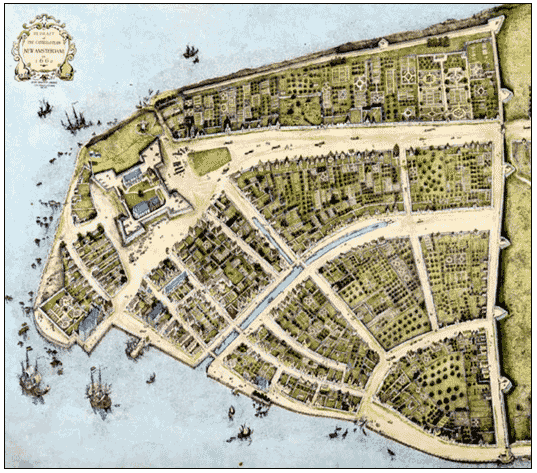
Castelo Plan

The image is of the Castelo Plan (Wikipedia) and illustrates what the Dutch city of Nieuw Amsterdam appeared like at about the time Jan and Volkje Van Husum arrived.


Den Harinck

The ship den Harinck is included in a list of ships transporting early pilgrims to America. See Packrat. The list only includes passengers on an earlier voyage in 1637.

An updated list by the OliveTreeGenealogy for den Harinck May 1639, still does not include the name Van Husum.

Rennselaerwyck Settlers aboard the den Harinck 

A book by Arnold Johan Ferdinand Van Laer, entitled Settlers of Rensselaerswyck, 1630-1658, lists some settlers and the ships that they arrived on. Unfortunately, it does not include Jan and Volkje. Interestingly, it does record Willem Juriaensz, who arrived nine months earlier, and later in the history of Fort Orange had dealings with Jan Van Husum.

Settlers of Rensselaerwyck, 1630-1658 is available on Google Books. This source lists the voyage of den Harinck sailing 1637, arriving 1638.

The site lists other settlers (including Sander Leendertsz Glen, Andries and Marten Hendricksz, and Barent Pietersz Koijemans (Coeymans) sailing aboard den Harinck, from Texel in May 1639; arrived at New Amsterdam. July 7, 1639. The list may only include individuals working specifically for Rennselaerwyck.

The Journey aboard den Harinck

The ship set sail from Texel, an island off of the Dutch coast near Amsterdam. Texel was a common point of embarkation and hundreds of ships might lie at anchor at any one time.

Nothing is recorded of the voyage aboard den Harinck, but we do know that the voyage was quick, a journey of two months during the summer of 1639. We can therefore assume the journey was uneventful. By contrast is the voyage of den Harinck in September of 1637, which did not arrive until March of 1638, a journey of six months indicating that a winter's voyage was to be avoided. Settlers of Rensselaerwyck, 1630-1658, page 16.

Thursday, December 15, 2011

Why Volkje Juriens and Jan Fransse Van Husum came to America.

...
The back bone's connected to the neck bone,
The neck bone's connected to the head bone,
Now shake dem skeleton bones!

The Sailing


We know that in May of 1639, Jan and Volkje were married in Amsterdam Nieukirke. And that they set sail soon thereafter aboard the ship den Harinck. The two months crossing put them in New Amsterdam (New York) on July of 1639. Then they sailed up the Hudson River to the colony of Rensselaerswyck to start a new life.

Why leave


The simple answer to the question of why Jan Franz Van Husum and his bride Volkje Jurians Nordstrand came to America is because of a flood. The Great Flood of 1634 to be exact. AKA, the Burchardi flood or the second Grote Mandrenke (Great Man Flooding). It was a flood of biblical proportions, arriving on the night of 11 October and continuing until the next morning. It struck the along the Holland coast and the western coast of the Jutland peninsula, loosely called North Frisia. Over ten thousand lives were lost, including Volkje's parents. Nordstrand Island, where Volkje lived with her parents and sister Annetje was devastated, villages and churches completely destroyed. Husum, then a seaport, was likewise devastated by the flood.

It was time to start a new life.

Jan and Volkje soon made their way to Amsterdam. Jan was 21, Volkje 16. They took up residence on the same street in Corte Tuiinstraat, between the two canals, the Lijnbaansgracht and the Prinsengracht. Whether they came together or separately is not known. How they met and when is not known. What they did in Amsterdam is not known.

Opportunity


Little is known. What is known is that they heard of the colonial estate of the Dutch patroon Kiliaen van Rensselaer, who was providing free passage to the New World. IN exchange the colonist would farm and provide services to the patroon, swearing the following oath:

I, ______ , promise and swear that I shall be true and faithful to the noble Patroon and Co-directors, or those Commissioners and Council, subjecting myself to the good and faithful inhabitant or Burgher, without exciting any opposition, tumult, or noise; but on the contrary, as a loyal inhabitant, to maintain and support offensively and of the Colonie. And with reverence and fear of the Lord, and uplifting of both the first fingers of the right hand, I say — SO TRULY HELP ME GOD ALMIGHTY. 


It was an opportunity.
 

Notes on the Great Flood


The people who lived along the Jutland coast waged a constant battle against the sea. Nature  represented by the Great Flood of 1634 won the battle and altered history.

 The Great Flood of 1634


Cor Snabel


Imagine my surprise when I came across Cor Snabel's site detailing the Great Flood of 1634. As a bit of pre-history, Cor Snabel explains that a similar flood occurred in 1362. And at that time, contemporary chronicles claim that whole parishes were wiped off the map and 100,000 souls perished. Another storm stuck in 1625, dividing the island of Strand in two. 


But man persists.

See Historic Storms of the North Seas.

Read also the German Wiki account of the Buchardiflut.


Monday, December 12, 2011

Dutch or Deutsch

This article should be revised over time.

In her history of  the VAN HOOSE VAN HOOSER VAN HUSS FAMILY IN AMERICA, Joyce Lindstrom states:

Jan Frantz Van Husum wasn't Dutch as many people have supposed. Neither was he German. He was a Schleswigan subjected to Danish rule. He spoke low German, probably with a Frisian or Danish dialect. However, after three generations of living among the Dutch settlers in New Netherlands, his descendants gradually became Dutch by association. There were also more emigrants in New Netherlands who were Danish, Frisian and Schleswigan than Dutch.

At a gut level, I have doubted this thought primarily because the strong Dutch characteristics prominent in any of the paintings by Rembrandt, Hals, or Vermeer, are also visible in the facial features of my wife's father and the other ancient images of Van Husses, Vanhoosers, and Van Hoesens that have been saved over the years.These features include the angular nose, the sharp chin, the brown eyes and hair, and, over time, the silver hair that comes with age. To walk among the paintings of the great Dutch masters in the Rijksmuseum, one sees the merry and sometimes somber faces of the Van Huss men and women. Rijksmuseum.

Then as now, populations were constantly on the move and the peninsula now called Jutland, where the province of Schleswig and the town of Husum are located, was no exception to the forces of history and events. As pointed out in Cor Snabel's story of the Nordstrand flood of 1634, the area was ravaged by the bubonic plague in 1603, then thrown into the turmoil of the Thirty Years War in 1613, and, worst of all, subjected to a catastrophic flood in 1634 that forever altered the landscape and the lives of the Jan Van Husum and his bride to be Volkje Juriens.

Frisia from Wikipedia
A broad historical overview of the area give us the impression that the people who lived in the area were like the tides of the ocean subject to the forces of nature. The Romans called the tribes who inhabited the area Jutes, hence the name Jutland. The area's geographical significance was in the fact that the peninsula was a conduit for the transfer of goods between the Baltic and Russia to the east with the Rhine River valley and the Atlantic to the west. During the Middle Ages, the Danes established Viking control of the area. And even today, the northern part of Jutland remains Danish territory.

But, as Joyce Lindstrom observes there was one other group that figured predominantly in the region, the Frisians. Roman history records that the Frisii began settling the area along the northern coast of present day Netherlands and northwestern Germany around 400 B.C.. Ethnically, they were a Germanic people who spoke Frisian, a language related to the English. Like those who live in the area today, the Frisians struggled with the North Sea, constructing their homes on terps, man-made hills. They gained their living both from the sea, but also from the small farms they built where they kept their cattle and sheep.

There is a good discussion of  the Frisian language, still spoken by a few people on North Frisian Language,Wikipedia.

The Netherlands and the people we call the Dutch includes a much larger area than that indicated on the map. Instead, today's Netherlands are what was known as the United Provinces who rose in revolt against their Spanish overlords during the Eighty Years War.

Joyce Lindstrom is likely correct that Jan and his wife Volkje spoke a form of German. But, the distinction between German and Dutch is more one of dialect than distinct linguistic differences. In any event, the people who lived and worked along the North Frisian islands that included Nordstrand and the town of Husum, likely thought of themselves more as Dutch than German.

We know this for many reasons. First, name spellings of Jan and Volkje are common Dutch spellings and not German. The German spelling is typically Johann, but sometimes Jan or even Hans. Moreover, Jan Fransse Van Husum is the Dutch spelling. Even more telling is the name Volkje, which in Dutch means folk or common people. The German spelling is "volk" as in Volkswagen. Volkje family name Juriens, sometimes spelled "Juriaens", is often found in Holland, less so among Germans.

Other evidence of the Dutch association comes from the excellent historical article of the Flood of 1634 by
Cor Snabel, mentioned above. The flood of which Cor Snabel speaks must rank as one of the most catastrophic of that century. More than 15,000 people lost their lives, and on the island of Norstrand, where Volkje lived with her parents and sister, more than 6,000 died. Whole cities were washed away, the island of Norstrand was inundated and broken up into three smaller islands. Farm lands, which were covered by sea water, were ruined, with the result that many farmers packed up and left.

map of Nordstrand by Johannes Blaeu 1652
What Cor Snabel tells us is that four years prior to the flood, the German prince then ruling (he replaced a Danish ruler in 1627 during the Thirty Years War), hired a Dutch overseer, Jan Adriaansz Leegwater, who lived in the town of  Dagebull, a few miles north of Husum. His recounting of the terrible details of the flood and the names of the victims indicates that most if not all of the victims were Dutch in ancestry.
On the day before All Saint’s in the year 1634, when I was working as an engineer and a surveyor in the Bottschloter project, a big southwesterly storm came from the sea. At seven or eight in the evening, I visited the house of master carpenter Pieter Jansz, who was from Friesland, and who worked on a big new sluice in the project I was supervising.
Leeghwater continues, describing the aftermath of the flood.
Next morning, we saw and heard that all 37 houses of the workers were washed away, including all the people therein. Dikes, which had held up for more than 100 years, were destroyed. That day I took a boat and sailed to the village Dagebüll. The priest told me that the water had reached the level of almost five feet within the church, where people had found shelter. The house of master carpenter Pieter Jansz and the house of Pauwels Harmensz, where I had been before the storm, were vanished. Pieter Jansz and his wife and children had drowned, as had Pauwels Harmensz and his servant, who had accompanied me to my house. And there is more: early in the morning, my house was washed from the dike. The mansion was severely damaged, the cellar was like a ruin, and all the wine and beer had washed away. Big sea ships were stranded on high dikes, as I have seen myself. Several ships were stranded in the higher streets of Husum. I’ve been on the beaches, where I have seen horrible things. Countless dead bodies of people and animals, along with beams of houses, smashed wagons and lots of wood, straw and rubbish.

Aside from these few facts, we know that after the flood Volke was taken to the city of Husum. She met Jan, they moved to Tuinstraat in the city of Amsterdam.  The word "corte" is Spanish for court or section - not unusual since the Spanish had ruled the area for years. Tuijnstraat or Tuinstraat, as it is now spelled, is still to be found in Amsterdam, close to Anne Frank's House.

In 1639 Jan and Volkje embarked on a voyage to the New World. Whether Jan Fransse Van Husum was Dutch or Deutsch by birth, he certainly became Dutch by association, and to anyone who knows Bob Van Huss, it is the Dutch in him that we see.


Sunday, December 11, 2011

Disaster - the Flood of 1634

If you are looking for the event that brought Jan Fransse Van Husum and Volkje Juriens together than it is surely the flood of October 11, 1634. This flood was one for the history books. It struck the island of Nordstrand and the neighboring coastal town of Husum on the night. Thousands of lives were lost.

Hardest hit were the North Frisian Islands off the western coast of Schleswig. Among these was the island of Nordstrand where Volkje lived with her parents and sister Annetje. Jan live in the neighboring port city of Husum.

Much has been written by Joyce Lindstrom and others as to whether Jan and Volkje were Frisians, Dutch, German, or even Danish. I doubt there is a simple answer. Originally, the area was settled by the ancient Frisians who were know as far back as Roman times. Then again, by 1634, the area had been settled by numerous Dutch immigrants who were in the process of reclaiming land from the sea with the use of dykes and windmills. After the flood of 1634, hundreds, if not thousands, of survivors made their way to Amsterdam. A number of these emigrated to America.

The storm was intense. Dikes, which had held up for more than 100 years, were destroyed. Over 6,000 people died, dozens of towns were washed away. The island of Nordstand, where 16 year old Volkje lived with her parents and sister, was inundated and broken up into several smaller islands.The town of Husum, just to the east of Nordstrand, was likewise devastated. Farms were rendered useless by the salt water that covered the fields and saturated the ground.

Volkje parents did not survive the storm. Afterwards, she was taken to the neighboring town of Husum. There she met Jan Fransse Van Husum.

The map, dated 1652, to the left is by Johannes Blaeu. The large island of Nordstrand was submerged and broken up into several smaller islands. Blaeu's map shows the majority of the island still underwater in 1652. Those who survived went back to the ancient custom of building houses on a hillock as a defense against the floods.

A chilling eye-witness account of the storm exists. Cor Snabel's story of the Nordstrand flood of 1634.

There was nothing left in Husum and Nordstrand for Jan and Volkje. Later records would reveal that land reclaimed by the sea not recovered by owners reverted to the state. Other settlers were brought in in order to reclaim former lands.

At some point, Jan and Volkje would move to Corte Tuijnstraat in Amsterdam. The word "corte" is Spanish for court or section, and the street (straat) Tuijnstraat still can be found in Amsterdam. The street is just around the corner from the Anne Frank House. It is a little further to the house of  Rembrandt van Rijn, who was then an up and coming painter. Rembrandt married his bride Saskia in the same year as the flood.And in 1639, bride and groom purchased a house on the Jodenbreestraat. Unhappily, Saskia would die two years later.

Jan and Volkje's marriage fared better. In 1639, they would marry in the Nieuwe Kirk of the Dutch Reformed Church. Within months, Jan and Volkje were on their way to New Amsterdam, then to Upstate New York.

There are thousands, if not tens of thousands, of people living in the United States who owe their lives to the flood of 1634. My father in law and wife are among the group. Interestingly, Gary Boyd Roberts in Ancestors of American Presidents, p. 13, 269, lists Jan Fransse Van Husum as the sixth great-grandfather of Theodore Roosevelt, Jr., 26th President of the United States of America.


Saturday, December 10, 2011

The Beginning - Holland and Husum

How much can be learned about Jan Fransse Van Husum, the first Van Huss in America?

Four centuries have erased any images, personal letters, and artifacts that might give us an insight into Jan's life. Still, a few historical records have survived since 1639 when Jan and his new wife Volkje Juriens sailed from Amsterdam in the Old World for New Amsterdam in the New.

One, we do know that on March 28, 1639, Jan and six others signed on with Killiaen VanRenssalear to serve with the West India Company in New Amsterdam for four years.

Van Hooze History and Court Records Page

Holland

The Amsterdam that Jan and Volkje lived in before departing for the New World was a commercial hub. The United Provinces of which Amsterdam was the principal city, was engaged in a decades long struggle with Spain for political control. In 1639, a Dutch fleet convincingly defeated a larger Spanish fleet at the Battle of the Downs and ended Spanish interference in Dutch political affairs.

For a brief time Holland and the Provinces bloomed. Its commercial success was undoubtedly the result of many factors including its tolerance of differing religious views, its openness to immigrants, and the free-spirit of its capitalism. Success can be measured in many ways. Amsterdam transformed from a city of 50,000 in 1600 to 200,000 in 1700. Its harbor contained thousands of ships. And these ships sailed to the four corners of the earth, establishing commercial ventures and new colonies everywhere. The East Indies Company was perhaps the most successful of these ventures, but lesser known was the West Indies Company with which Jan signed up.

It is tempting to set sail for the New World with Jan and Volkje. But we shouldn't get ahead of ourselves. From Joyce Lindstrom's History detailing the marriage record of Jan and Volkje:
The church banns of April 30, 1639 are translated thus: "Appeared as before, Jan Franz from Housum, sailor, age 30 years, living in the Corte Tuijnstraat, having no parents but assisted by his cousin, Anna Jans, and Volckje Juriaens (daughter?) from Noorstrant, age about 21 years , of the same (street), having no parents, but assisted by her acquaintance, Isaack Pietersen. " They were married in the Dutch Reformed Church at Nieuwe Kerk at Amsterdam, Holland on May 15, 1639.
Tuijnstraat still exists on the map of the city of Amsterdam and can be found intersecting with the canal Prinsengracht, near the Anne Frank House. Tuinstraat, as it is spelled now, is still a residential area where an apartment can be found for 1750 euros a month.

Likewise, the Dutch Reformed Church at Nieuwe Kerk can still be found a short distance away at 17 Gravenstraat, next to the Royal Palace. Today, the church is no longer used as a church, but is now an exhibition space. Learn more about the Nieuwe Kerk.


Husum

Husum North Sea by Anne VanHoozer Burke
Jan had a father named Frances or Franz, or Fransse, depending on the language one uses. He was born about 1582, probably in Husum, Schleswig-Holstein, now part of Germany.

Husum is a seaport as far north in Germany as one can go. The city is described as the "Grey City" which is accurate as a description of any city on the North Sea in winter. A stiff breeze blows often making the area a center of wind power. The buildings are often pained in gay colors to offset the greyness of the sky.

http://www.deutschland-reise.de/stadt/husum/

I have not been there, but Anne VanHoozer Burke has.Click on her web page above and you will see several images of the city in winter.

It is likely that the landscape of the coast of Schleswig has not changed much in the intervening years since Jan lived in Husum. A description of Holland's north coast by one of Louis XIV's ambassador's in 1699 would probably fit the coastline of Schleswig as well. It is "...taken up on the seaward side with barren sand-dunes, subject ... to frequent flooding, and fit only for the grazing which is the country's sole wealth..."

View a 360 degree panorama of Nordstrand.

map of Johannes Blaeu, 1652
The flooding came from the cruel North Sea.

In 1634 a terrific gale hit Nordstrand, an island just off the coast where Husum is located. The sea swallowed more than half of the island, breaking it up into three smaller islands. More than 6,000 people drowned, over a thousand farms and houses were washed away, as were 28 windmills and 6 clock towers.

Among the dead were Volkje's parents. After the storm Volkje and her sister moved to Husum, where no doubt Volkje met Jan. The flood devastated the entire area. The salt from the sea covered the fields, rendering them useless. No doubt, this was the reason why Jan and Volkje moved to Amsterdam.

"The Van Hoose, Van Hooser, Van Huss Family in the United States", by Joyce Lindstrom